Packaging has undergone a significant evolution over the years, transforming from a mere container into an essential tool for marketing, communication, and sustainability. Its history is closely linked to societal changes, technological advancements, and shifts in consumer habits, adapting to new demands and global challenges.
The first forms of packaging date back thousands of years, when humans used natural materials like leaves, animal hides (such as goat skin flasks) and clay to store and transport food and liquids. These rudimentary materials served a purely practical function: protecting the contents from external elements and extending their shelf life.
With the rise of civilizations, packaging evolved to meet new preservation and transportation needs. In ancient Egypt, amphoras were used for wine and oil, while the Romans adopted glass bottles and wooden crates to facilitate long-distance trade.
With the Industrial Revolution in the 18th century, packaging began to play a crucial role in mass-market economies. Large-scale production and expanding trade required more robust and standardized packaging solutions to protect products during transportation and storage. During this period, materials such as cardboard and paper became widespread due to their lightweight, versatile, and easy-to-produce qualities.
This marked the transition from the concept of a simple “container” or “packing” material—designed for protection and preservation—to “packaging” as an aesthetic and communicative concept. The box became an essential, integral part of the product.
When, in the 1920s, Francesco Lotti opened his workshop, boxes and cartons were predominantly handmade. Technology hadn’t yet reached today’s levels, so craftsmanship and manual skill were paramount. A popular item at the time was women’s hats. The “modiste” (hat-makers) would deliver these in large, round boxes known as “hat boxes.” These boxes had a ribbon handle to allow the customer to carry the box on their arm without it tipping over and risking the hat’s shape.
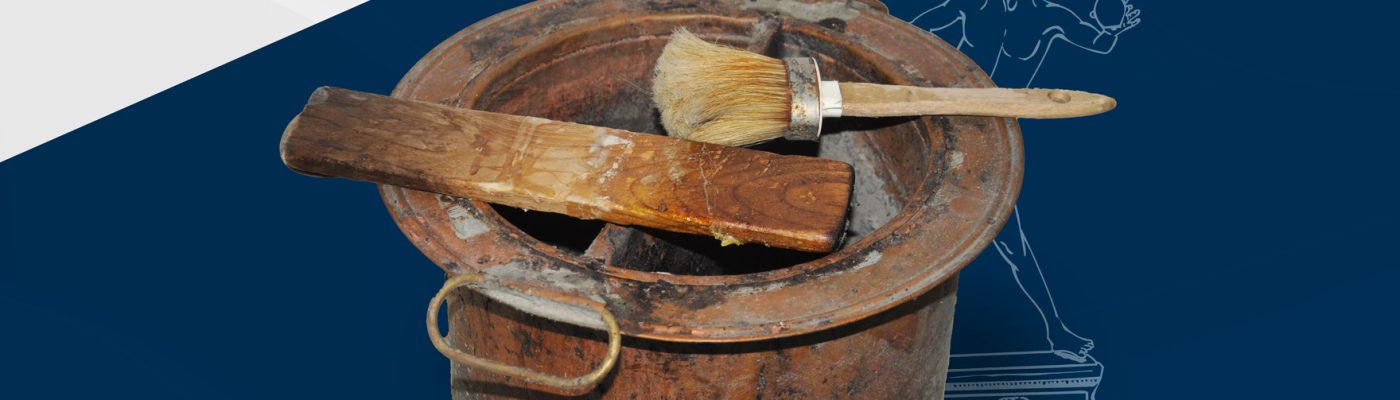
Francesco Lotti handcrafted hat boxes, cutting circles with curved scissors that allowed him to follow the drawn outline on the cardboard, creating the box’s base and lid. The outer band of the hatbox was wrapped by hand, starting from a cardboard strip with edges carefully joined without overlap. A strip of paper was glued around it using fish glue, a traditional adhesive heated in copper pots over a water bath and spread on marble with a brush. Speed was essential to ensure the glue’s quick adherence, a meticulous process that required great experience and skill.
Over the years, packaging has continued to evolve, necessitating specific expertise and giving rise to new professions such as Packaging Designer. Today, launching a new product—or relaunching an existing one—requires packaging development that often outlasts the product itself, becoming a keepsake or standalone item. It’s common to see empty perfume boxes, wine or liquor bottles displayed on shelves, even in public venues, for their aesthetic appeal. They evoke memories of the associated product.
As mentioned, modern packaging development requires expertise across design, material science, and marketing to create packaging that is attractive and intriguing. Beyond simply accompanying the product, it enhances and exalts it, creating anticipation and desire among consumers.
Packaging has come a long way, evolving from a simple means of preservation to a powerful tool for communication, marketing, and sustainability. Today, companies face increasingly complex challenges to provide functional, attractive, and eco-friendly packaging solutions.
In this ever-changing landscape, Lotti stands as a reliable partner for creating custom, sustainable, and innovative packaging solutions that highlight each product and meet modern consumers’ needs.